
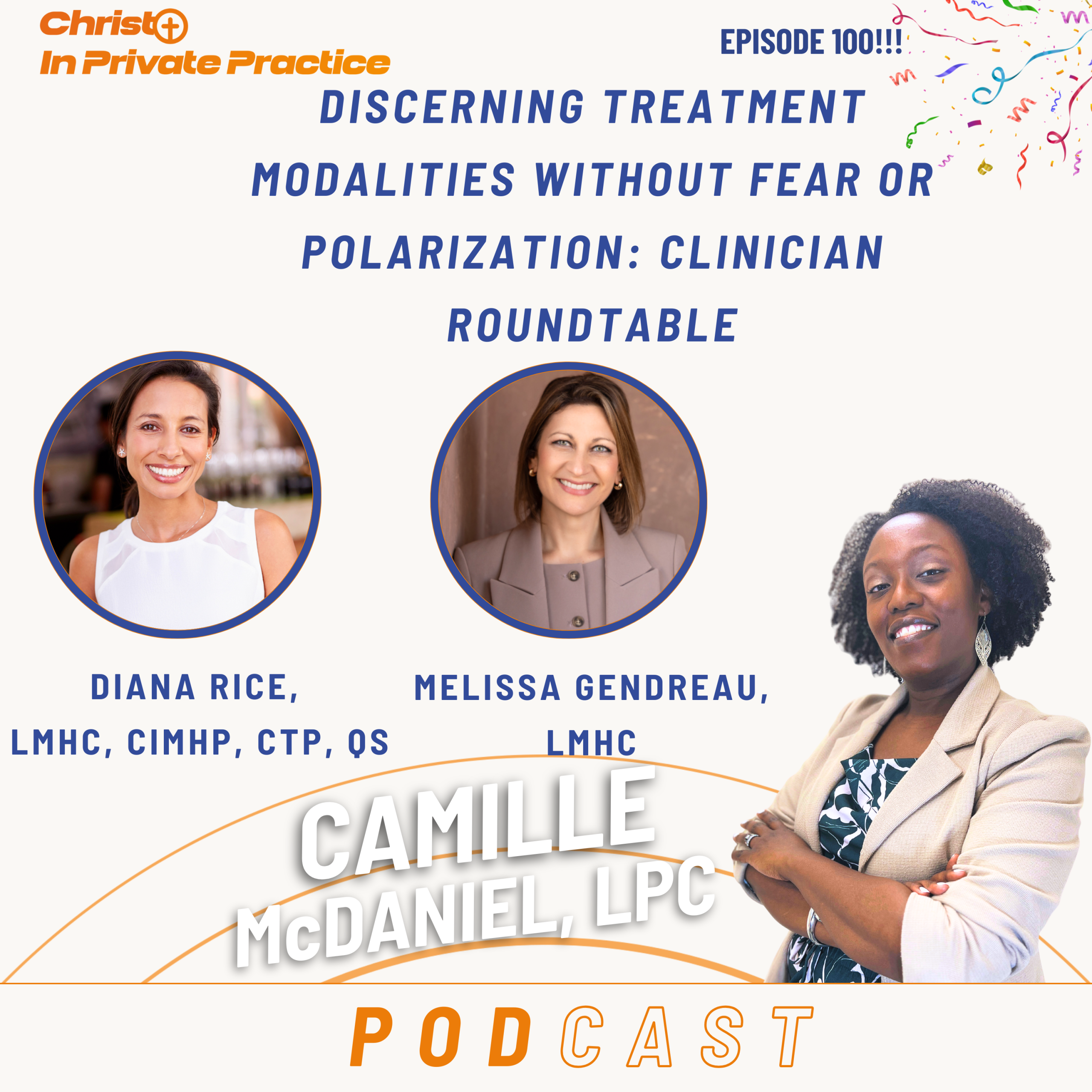
Episode 100
Discerning Treatment Modalities Without Fear or Polarization: Clinician Roundtable
Show Notes
How Christian Clinicians Discern Treatment Modalities Without Fear or Polarization
This roundtable brings together Camille McDaniel, LPC with Diana S. Rice, LMHC, CIMHP, QS, and Melissa Gendreau, LMHC to explore how Christian clinicians can evaluate treatment modalities with wisdom, humility, and ethical clarity. The conversation focuses on self-awareness, discernment, and staying relational even when clinicians disagree.We discuss how personal history, theology, and clinical training shape our reactions to new modalities, why social media can amplify fear and black-and-white thinking, and how to tell the difference between Holy Spirit discernment and simple discomfort.
Diana S. Rice LMHC, CIMHP, CTP, QS
https://www.transformedmindcc.com
Helping Professionals and Organizations Communicate Mental Health With Confidence and Clarity
The Holistic Counselor Podcast
Melissa Gendreau LMHC
Forward Path with Melissa Gendreau Life and Marriage God’s Way
Podcast Episode Transcript
Camille McDaniel, LPC (00:00)
Okay, before we jump into today’s episode, I have to take just a minute because this is episode 100 of Christ in Private Practice podcast. 100 episodes. So whether you’ve been listening from the very beginning or you just recently found the podcast, thank you. Thank you for listening, for sharing.
For sending your thoughts and your questions and for just being part of this growing community of Christian mental health professionals. I cannot think of a better way to celebrate episode 100 than with wonderful colleagues. And today I am joined by two returning guests for some thoughtful, honest, and sometimes funny conversation that I love having whenever I have somebody here on the Christ in Private Practice podcast.
So thank you for helping me reach 100 episodes. Who knew that when I decided to record the very first episode? Not even sure if where it was gonna go or what exactly I needed to do besides the direction that the Lord gave. And you can just listen to episode number one so that you can hear the full story. Who knew that it would lead to everything?
that has happened between episode one and episode 100. So again, thank you and let’s go ahead and get started with episode 100.
Camille McDaniel, LPC (02:04)
Welcome back to another episode of Christ in Private Practice. Today we have not one but two guests, and I am very excited. You have seen both guests before. They’re going to introduce themselves as I was talking to them a little bit earlier because everybody has great things that they’re doing, and those great things do change. Some may have things that are coming up very quickly, but we still want to congratulate them on.
What they are accomplishing and what they’re creating and where we can join in and participate. We absolutely want to because they’re doing great things in their own right, each of them. I am going to talk today from us kind of looking at the angle of before we actually evaluate different treatment modalities.
We want to actually break down how are we coming to these conclusions and how are we actually working together as a body of believers who are also mental health professionals so that when we don’t see eye to eye on things, it doesn’t destroy relationship. But we’re gonna talk more about that in today’s episode because we wanna be able to make sure that as we move forward, providing the care that the Lord
has gifted us to provide and the studying that we’ve done and the training, we are able to move forward as professionals, as believers, and not allow our differences to destroy the relationship within the body of believers, which sometimes I had just noticed, you know, and I know many of you may have noticed as well, that can absolutely happen when we have something we are very passionate about and we believe is correct.
And then we have a colleague who may also have our same worldview, our same value system, but they believe something else. And somehow it just causes us to spiral into falling out and not always being as gracious with one another. And so we’re gonna talk about that round table style. But before we jump into our first set of questions, I am going to invite each of the clinicians who are here today.
who are from different parts of the US to introduce themselves and then we will move into what we are going to be talking about today.
Thank you so much, Diana, Melissa, for being here again. It’s a joy. So that we don’t have a verbal traffic jam, let me just ask, let’s ask. Diana, can you start please introduce yourself? And then Melissa, can you please introduce yourself and we’ll move on from there.
Diana S. Rice, LMHC, CIMHP, QS (04:58)
Hi, everybody, or how I usually say hello there, fearfully and wonderfully made human. I am the host of the Holistic Counselor Podcast. I am a licensed mental health counselor, certified integrated mental health professional, and a qualified supervisor in the state of Florida through Through the Valley Therapy. And I also just started Transform
Melissa Gendreau (05:19)
Yeah.
Diana S. Rice, LMHC, CIMHP, QS (05:20)
Mind Consulting and Coaching, and it’s more for
I would say creating CEUs or educational workshops or just to try to bring practical tips with mental health. And if churches wanna hire me too, I also know how to integrate the biblical worldview. So that’s who I am. You can check out my website.
Camille McDaniel, LPC (05:42)
Melissa, please introduce yourself.
Melissa Gendreau (05:45)
Hi, I’m Melissa Gendro. I’ve been a mental health counselor for 16 years. This last year has brought quite the pivots. So I have started a new business as well. So I started Forward Path with Melissa. I have a podcast. It’s Forward Path with Melissa, Life and Marriage God’s Way. And then I created some coaching programs, some courses. And the focus of that is really more on growth.
so being able to differentiate that from therapy, where we’re focusing more on healing, or healing is the starting point. and then real recently, I have just started supervision for in training therapists in Iowa. and then I have also started some consultation programs for the the Christian.
Clinician who is wanting to get into their own private practice and how to navigate the world of private practice, integrating faith, and doing that with ethically and with integrity. And then also for maybe the person who is in private practice, the Christian who is just wanting an extra set of eyes to be able to take a peek at their information, their marketing, their documentation.
’cause we can all have blind spots and just to be able to have another person take take a point of view. So that’s real new, but
Diana S. Rice, LMHC, CIMHP, QS (07:18)
That’s wonderful.
Camille McDaniel, LPC (07:19)
Yes, thank you. Thank you both. both doing great things in your community and actually outside because it goes state to state and possibly even out of the country, depending on what you’re looking for. Yeah, and that’s awesome. Love to hear those things. And these are some of my favorite people to have on the podcast. And so with that, we are going to rock and roll into today’s topic, which is gonna be how Christian clinicians discern treatment modalities without fear or
Polarization. And we’re going to really deep dive and we’ll get to as many questions as possible, but we’re not so focused on number of questions as the depth.
of responses that we can provide you as we kind of talk through this ourselves. So everybody has an understanding of the questions, but we have not talked about this before. And we all can talk quite a bit. So we are going to get started with the first question. So the first question that we present today is when we encounter a new treatment modality, what assumptions are we bringing with us?
Based on our backgrounds and our values, before we ever even begin evaluating that treatment modality.
Diana S. Rice, LMHC, CIMHP, QS (08:43)
Okay. Well, I could I’ll start if you want me to. I
Camille McDaniel, LPC (08:46)
Absolutely.
Diana S. Rice, LMHC, CIMHP, QS (08:47)
well, you have to really think about we all bring our own family stories, our culture, our church tradition, our education, our wounds, our clinical training, our personality, ideas about what healing should look like. So before we even ask, what is wrong with this model? I need the courage to ask what is happening inside of me as I encounter it.
That is not moral relativism, it’s just honest self examination.
Camille McDaniel, LPC (09:16)
Absolutely.
Melissa Gendreau (09:17)
Yeah, Diana, I don’t know that I could say it any better. I I mean, I I think that we we really as kind of the the gatekeepers for our clients, regardless of where they are coming from, what worldview they’re coming from, what faith they’re coming from, we need to be able to be really honest with ourselves of where are our
our our views, where our blind spots, where our maybe unhealed wounds or at various levels of being healed, so that we aren’t unintentionally bringing any of those assumptions into our our office, or even before we bring that modality potentially into our office.
Diana S. Rice, LMHC, CIMHP, QS (10:03)
Right. Yeah.
Camille McDaniel, LPC (10:06)
Couldn’t say it better. I don’t even know that I have a lot more to add to this particular question, except for to just say that I think the reason why what each of you said is very important. There’s a many reasons why it’s important, but one that pops up first for me is because we want to make sure that our blind spots don’t cause us to just totally shut the door on understanding certain modalities or maybe changing them to.
kind of suit us and not necessarily look at how it might impact the client. We just, you know, and which I know you all were talking about the blind spots and and looking at who we are and making sure that when we go into anything, that we’re not going in kind of twisting it to make sure that we’re comfortable, but that we are seeing it fully for what it is. And then making a decision on maybe it doesn’t work for us. Yeah. Okay.
Diana S. Rice, LMHC, CIMHP, QS (11:02)
Well, I I really think too, like some well, it I can speak about my own personal experience, right? ‘Cause my own trauma history, my own immigrant family story, my clinical training, my experience with high control religion, that sharpens my awareness. Okay. So, you know, they can also shape what initially feels safe or threatening. So self-awareness is something that every human being in this field should really take a step back and pause in and
Breathe into it and be like, okay, why do I believe what I believe and what makes me right?
Camille McDaniel, LPC (11:39)
So then even when you say that, I’m like,
Melissa Gendreau (11:42)
Yeah.
Camille McDaniel, LPC (11:43)
we’re about to check a left tower, here we go.
Diana S. Rice, LMHC, CIMHP, QS (11:45)
Ha ha ha.
You ha you gave
Camille McDaniel, LPC (11:49)
You know, really
Diana S. Rice, LMHC, CIMHP, QS (11:50)
us these questions and I every single day I mean, how long ago did you give us these questions, Camille?
Camille McDaniel, LPC (11:55)
It just
may it may have just been a little over a week or so, something like that. Not bad.
Diana S. Rice, LMHC, CIMHP, QS (11:58)
Right. And so me
I because I want to be prayerfully I d you know, I do not want to go in with reacting in emotion. I want to respond in wisdom. And to respond in wisdom is to actually sit in prayer and and in the word and in context
Camille McDaniel, LPC (12:12)
Mm, yes.
Diana S. Rice, LMHC, CIMHP, QS (12:14)
and go and also I’m older too. So it’s like the experiences I have now. It’s you know, at twenty-five I didn’t see Christianity like I see it now or you know, and so it’s just like chewing on it.
Camille McDaniel, LPC (12:26)
Yeah, it’s
Diana S. Rice, LMHC, CIMHP, QS (12:28)
Melissa, how what w how’d you do this with all the questions?
Melissa Gendreau (12:31)
Yeah.
Diana S. Rice, LMHC, CIMHP, QS (12:31)
‘Cause I got over I not overwhelmed, but I like excited and at the same time I’m like, gosh Lord, like I don’t wanna I don’t wanna mess anyone up.
Melissa Gendreau (12:36)
Right.
No, so much. And I I think I think I was looking through the questions too and yeah, praying over them. And then I I was trying to hold them loosely too, right? Because I didn’t I don’t I didn’t want to get so stuck in how I wanted to answer and then not be hearing either one of you guys too. So I was like, well.
Here’s how I would answer it if they weren’t here, and yet I will tell you.
I’ll let it go loose in case, you know, whatever I want to add on to or feel really prompted to be able to say. But I love your answer of not wanting to to add to any of this from an emotional standpoint. And I I think that’s so true, whether we’re having this conversation here or honestly, as the therapist in the room, right? it is, it is not that emotions are.
Are bad, obviously, right?
Diana S. Rice, LMHC, CIMHP, QS (13:38)
Right.
Melissa Gendreau (13:39)
Like our emotions are important and they’re information and it’s data, right? But when
Diana S. Rice, LMHC, CIMHP, QS (13:44)
Yes, exactly.
Melissa Gendreau (13:46)
we start giving it more credibility and more weight than that, we can get ourselves into a lot of trouble. and we can find ourselves being kind of all over the board in our therapy sessions and
And that’s one of the most important things that we are to be is the steady in the room. and so our ability to be able to handle and manage whatever topic comes our way. And I think that’s the that’s an art form as a therapist that you just have to learn how to do. And like you’re saying, as a, as a 25-year-old, whether you know it’s understanding Christianity better now with more wisdom and discernment.
It’s also how do you sit in those spaces and sit in that room when you have more experience and and when you have more time with understanding yourself, with understanding how to navigate other people’s thoughts and emotions. that takes it it just takes time. It’s not always something that can just be taught. so
Camille McDaniel, LPC (14:58)
And that’s where I think I I wanted to be able to have this conversation with the two of you because I know that both of you can agree in ways that are not disagreeable. You can still say, okay, I see that point. I think I lean a little bit more this way, or I I think maybe I resonate a little bit more with this angle. And sometimes that’s what’s missing. Sometimes we might we might have such strong feelings about certain things based on our life experiences, based on our training, that when we
Hear about a treatment modality that someone’s using. And again, I’m not talking about just any clinician. I’m also talking about clinicians who are believers in Christ because there are certain ways we should definitely interact with anybody, but absolutely there are certain ways that we should act with one another. So if one of us is coming with our own ideas of what it means to
To treat someone well, right? And another person’s coming with their ideas of what it means to treat someone well and also be in line with Christ, then if those two things bump up against each other, how do we deal with each other? Because again, we’re gonna be talking a little bit about how we can navigate things without polarizing ourselves from one another. So if I get to a space where I’m holding so steady to these things that I believe to be true and I believe to be right that I can’t even hear you.
You can’t even come with counsel, let alone wise
Melissa Gendreau (16:22)
Mm-hmm.
Camille McDaniel, LPC (16:23)
counsel. I don’t know what kind of counsel it is, because I’m not hearing you. I can’t discern a thing.
Diana S. Rice, LMHC, CIMHP, QS (16:27)
But isn’t that black and white thinking? Isn’t that something we’re taught and clean as a clinician is to to challenge
Camille McDaniel, LPC (16:32)
Yeah.
Diana S. Rice, LMHC, CIMHP, QS (16:34)
to challenge that black and white thinking or all or nothing?
Camille McDaniel, LPC (16:37)
Yes, but then that’s where we know ourselves, right? Know our background, know our experiences because we can know where our sensitivities lie if we are able to just be clear on who am I as I go into this conversation. So am I hearing that you are possibly just trying to with a a sincere heart get me to see another angle that you feel really needs to be looked at? Or do I hear that you’re rejecting my knowledge and you’re rejecting my training and therefore you’re rejecting me? You know, I I
depends on who we’re talking to. But the important part of what I’m hearing is we have to be aware of everything that makes up who we are and what that means when we come to the table to have these types of discussions on how we are going to move forward in providing care for our clients. yeah.
Diana S. Rice, LMHC, CIMHP, QS (17:26)
think it we’re also in a time in history and in culture because I the frustration is going on social media. Cause I don’t
Camille McDaniel, LPC (17:35)
Yeah.
Diana S. Rice, LMHC, CIMHP, QS (17:35)
see this kind of argument when it’s like I, you know, I’m in a group with a hundred clinicians and we meet
Camille McDaniel, LPC (17:39)
Mm-hmm.
Diana S. Rice, LMHC, CIMHP, QS (17:40)
and we and we’re all from different churches from all denominations, but we all love Jesus. But what I what I’ve seen, and and the thing is a lot of the younger generations, Gen Z, Millennials, Gen Alpha, and whatever’s coming after that,
They’re this is this is part of the norm for them. And so is
Camille McDaniel, LPC (17:58)
Yes.
Diana S. Rice, LMHC, CIMHP, QS (17:59)
this why this was div you know, because I want to know, like, you know, this is something you’re passionate about for us to come together. It was what what got you to want to have this conversation with us?
Camille McDaniel, LPC (18:12)
Because I feel a disconnect. So as you’re talking about
Melissa Gendreau (18:15)
Mm-hmm.
Camille McDaniel, LPC (18:15)
a lot of things on social media, I can feel a disconnect. The Lord has had it on my heart for a long time. I just feel as though we are more and more separated from one another. So offense is more easy to kind of slip on in there. And I think the reason why we can be in groups like you’re talking about, Diana, you’re, you know, in large groups and you do a lot of networking and making really strong relationships with other clinicians.
because you’re taking the time to get to know each other, right? And so when we take the time
Melissa Gendreau (18:46)
Mm-hmm.
Camille McDaniel, LPC (18:46)
to actually build genuine connections with one another, I’m not getting offended because you said, Camille, I don’t really think that’s exactly how to look at it. I’m like, okay, well tell, tell me, you know?
Melissa Gendreau (18:59)
Right. Right.
Camille McDaniel, LPC (19:00)
Sometimes,
especially when we’re talking to other believers, maybe the Holy Spirit is talking to you. Maybe I’m really just not open. And the Holy Spirit’s like, all right, Camille, you’re doing a lot. That’s okay. I got someone else. I’m gonna work through that and I’m gonna work to get you, right? You know? and I and I think because we don’t form genuine connections in the same way anymore, because a lot of things are online and there is, yep, a lot of good connection that we can make online,
Diana S. Rice, LMHC, CIMHP, QS (19:27)
Yeah.
Camille McDaniel, LPC (19:27)
but there’s still
a difference between even taking the time online. So when when I see something online and I make a comment, I’m not necessarily building connection with the person who posted unless I’ve had a conversation with that person online, even if it’s online. It’s not enough to just say, well, I comment on them all the time. I see them all the time. Did you message them?
Did you say, hey, I’ve seen a lot of your your your information online. It looks great. I totally resonate with it. I just wanted to at least say hello virtually. And then that builds. And then what does that create? Safety. At least that, you know, that these are the steps that I see us being able to create. And that safety allows me to look at you differently.
And I don’t
Melissa Gendreau (20:14)
Mm-hmm.
Camille McDaniel, LPC (20:14)
just come thinking that it’s about who’s right and who’s wrong. Because
Diana S. Rice, LMHC, CIMHP, QS (20:18)
Right.
Camille McDaniel, LPC (20:19)
through genuine relationship, I actually see that I don’t think that you would do that just to one up me. I don’t think that you would do it just to make me feel bad about my choices. I think that you just are coming genuinely seeing it a different way. And I’m open to that, you know. But I think that there we have gotten away from that because
And and unfortunately we see this sometimes within the faith. We’re so black and white with is this right or is this wrong? Does God approve or not approve that we
Diana S. Rice, LMHC, CIMHP, QS (20:50)
Right.
Camille McDaniel, LPC (20:51)
lose sight sometimes of yes.
Diana S. Rice, LMHC, CIMHP, QS (20:52)
Right. Is this Calvinism or Armenians? I mean, like this is from the
beginning of time since Jesus from was on this earth. So it’s like these, these,
Camille McDaniel, LPC (20:59)
Absolutely. Mm-hmm.
Diana S. Rice, LMHC, CIMHP, QS (21:02)
and that is something though, in as a clinician, we really need to be aware because to me, we hold a big responsibility just like a pastor and a teacher. If especially
Camille McDaniel, LPC (21:11)
Mm-hmm. Yeah.
Melissa Gendreau (21:11)
Mm-hmm.
Diana S. Rice, LMHC, CIMHP, QS (21:13)
if we’re saying we’re a Christian counselor. Like if you’re saying you’re a counselor and you’re out there and you’re just
Melissa Gendreau (21:15)
Right.
Diana S. Rice, LMHC, CIMHP, QS (21:17)
a counselor out there in secular world that happens to be a devoted.
follower of Jesus, that’s one thing. But if you’re a Christ in private practice, that’s a whole other
Camille McDaniel, LPC (21:26)
Yes.
Diana S. Rice, LMHC, CIMHP, QS (21:26)
ball in my opinion.
Camille McDaniel, LPC (21:28)
No, and you’re right. It is a whole football game, right? It’s a whole
Melissa Gendreau (21:28)
Mm-hmm. Yeah. Yeah.
Camille McDaniel, LPC (21:32)
different standard. You’re not gonna go ahead and use Christ’s name and what you’re doing and then not follow what he’s asking you to do. And again, no, you shouldn’t, right?
Melissa Gendreau (21:40)
Well, you shouldn’t you shouldn’t.
Diana S. Rice, LMHC, CIMHP, QS (21:42)
Yeah.
Camille McDaniel, LPC (21:45)
But that’s why when we talk about like, okay, what had you want to bring us together? Because there is safety in wise counsel. And so
Even though we shouldn’t, and I know I’m not perfect, so I know that the Lord has kind of sometimes been like, I’m gonna bring it a different way. I’m gonna bring it through
Melissa Gendreau (22:04)
Mm-hmm.
Camille McDaniel, LPC (22:05)
this person over here. I feel like you’ll I’m gonna use my other my other kid over here to get you, okay? And I’m like, okay, okay. Sometimes I hear a thing.
And sometimes it’s just my own stuff that’s keeping
Melissa Gendreau (22:17)
Yeah.
Camille McDaniel, LPC (22:17)
me from moving forward. And then he uses an one of his children and uses one of his children. I’m like, okay, I’m I’m I’m I’m I’m listening. I’m trying, right? ‘Cause we’re not perfect. But
Diana S. Rice, LMHC, CIMHP, QS (22:27)
Right. Right.
Camille McDaniel, LPC (22:29)
What I think is happening sometimes is that the outside chaos that’s going on in the world has then seeped its way in. And we find ourselves feeling ways we probably shouldn’t be feeling and talking to each other in ways we shouldn’t be talking, and not being able to be wise counsel to one another when we are focused on is the person legalistic yeah, legally right.
Diana S. Rice, LMHC, CIMHP, QS (22:52)
Being right. Right. It’s it’s about
yeah, the assumptions
Melissa Gendreau (22:57)
Yeah.
Diana S. Rice, LMHC, CIMHP, QS (22:57)
of of being because I yeah, when I I
Camille McDaniel, LPC (22:59)
Mm.
Diana S. Rice, LMHC, CIMHP, QS (23:00)
can’t only handle I was on so off social media for a long time, on Facebook anyway. And then going back and I’m like, all right. And I looking through I can only handle it and looking through the comments because that’s the thing. I think it was the IFS question. Yeah. And do you
Camille McDaniel, LPC (23:14)
That’s what got us here. That’s what got us here.
Melissa Gendreau (23:17)
Mm.
Diana S. Rice, LMHC, CIMHP, QS (23:19)
remember the question?
Camille McDaniel, LPC (23:22)
I can’t remember the question that asked, but I did an episode on whether IFS and Christianity integrate. And I got the most comments I’ve ever gotten. But in that there was a learning lesson because I got some comments where some people didn’t necessarily know the details of it. They just knew that someone else said something. And
Diana S. Rice, LMHC, CIMHP, QS (23:47)
Mm.
Camille McDaniel, LPC (23:47)
then some people knew.
Just a little bit of what they read. And then some people were like, I just think that if that’s what you’re looking for, that’s what you’re gonna find.
And what I was looking for was I think I think I was looking for more depth in communication. I I mean, like, I’m like, hey, my mind sometimes works very, very black and white sometimes. when it comes to the Lord, I’m like, just tell me what the Lord said. Just start there, you know. And and so if you’re if you and I are having dialogue and you’re throwing in a lot of your feelings and opinions, I can’t work off of that. I appreciate it.
For sure, I I want the dialogue, but if you’re getting angry and all we’ve talked about is opinion, then we’ve not, if we’re talking about Christ, then we’ve not we’ve not hit the mark. Because we should actually be starting with how would the Lord want us to even be interacting? Before we get to what’s right, what’s wrong? How does the Lord want us to interact with one another, sisters and brothers in Christ?
Diana S. Rice, LMHC, CIMHP, QS (24:51)
Right. What’s the
posture you’re coming in with? What’s the intention of the heart? I agree.
Melissa Gendreau (24:54)
Yeah. Yeah.
Camille McDaniel, LPC (24:56)
Mm-hmm.
And then that had me think, okay, for the topic that we are on today, like, how can we do this better? Because sometimes we are we are not going to agree. But does that then just end the relationship? Is that even how that’s supposed to work? That’s not even how we work with our clients. We may not agree with a lot of things, but
Melissa Gendreau (25:17)
Right.
Camille McDaniel, LPC (25:20)
relationship is not about always agreeing.
Melissa Gendreau (25:23)
No. And I think Camille, you had talked about back earlier the the safety and wise council. But how many people
Camille McDaniel, LPC (25:31)
Mm-hmm. Mm-hmm.
Melissa Gendreau (25:32)
actually would believe or agree with that right now? And
Camille McDaniel, LPC (25:37)
Mm.
Melissa Gendreau (25:38)
I I mean, that’s that’s that’s a biblical understanding and that’s something that we are supposed to want to strive for. But I think there’s a
Camille McDaniel, LPC (25:46)
Yes.
Melissa Gendreau (25:47)
lot of people right now that, you know, you had made mention of depth.
I think social media and everything on the internet and all those things has robbed us of knowing how to have depth, right? Like we don’t take the time to think about our thoughts. We don’t take the time to reflect. We don’t take the time to process. And so because of that, we are actually not in tune to growing. We’re not taking the time to actually
Be renewed and
Diana S. Rice, LMHC, CIMHP, QS (26:25)
Mm.
Melissa Gendreau (26:25)
be the iron shipens iron and you know, all of those things. And all of that is what helps us to have maturity, is what helps us to grow, is what helps all those things. And when we don’t practice that ourselves as clinicians, when that’s not something that is a a regular and normal process of our own day to day.
We stop feeling, I guess, comfortable in our own skin and we stop wanting to seek growth. And then instead we start turning it into competition.
Diana S. Rice, LMHC, CIMHP, QS (27:04)
Hm.
Melissa Gendreau (27:05)
and we start turning it into, well, how am I right? How
Diana S. Rice, LMHC, CIMHP, QS (27:09)
Mm.
Melissa Gendreau (27:09)
am I gonna win? and so we start wanting to elevate ourselves by disparaging somebody else, as opposed to.
What are your thoughts? That’s really interesting. How’d you come up with that? I never thought of it that way. Right. And that just doesn’t become the conversation if we’re not actually interested or taking the time to understand how to grow.
Camille McDaniel, LPC (27:34)
Absolutely.
Diana S. Rice, LMHC, CIMHP, QS (27:35)
I I you know, you as clinicians, we should be trained to listen to understand, not listen to respond. Most humans pe like this is what I I know I do a lot of you know, most of my career I was in alternative high schools in Broward County, Florida. Okay. So it was a lot of just ever the the whole body’s on fire, right? ‘Cause you’re you’re living in high trauma, you’re living in anyway. And so it was like trying to get them to
Really, what you just said, Melissa, take that step back, that breath, because your body wants to fight or you know, fly out or be right, or you just want to be heard. Honestly, think about what the human condition really needs. Understood,
Camille McDaniel, LPC (28:18)
Yep. Mm-hmm. Mm-hmm.
Melissa Gendreau (28:19)
For sure.
Diana S. Rice, LMHC, CIMHP, QS (28:21)
to be heard, to be loved, right? And so you’re coming in with social media that has done the training with the dopamine hits, the quick things, the the fear of missing out, the FOMO.
The I better get a comment in there so people hear me and see that I’m here. Hello, I’m here. Because we do. We have a lot of practitioners out there. There’s a lot of Christian counselors. Anyway, it’s okay. This is part of the job, Camille. I hope I
Melissa Gendreau (28:51)
This is what helps me be able to now have a drink of coffee.
Diana S. Rice, LMHC, CIMHP, QS (28:53)
Yeah, there you go. I hope you don’t ed edit that out. I really, really because listen, people that are listening to this. No, I just
Camille McDaniel, LPC (28:59)
I just threw the phone over there.
Diana S. Rice, LMHC, CIMHP, QS (29:01)
saw that.
Melissa Gendreau (29:01)
Yeah.
Diana S. Rice, LMHC, CIMHP, QS (29:03)
Anyway, but it’s fear. And I think that goes to the question that you asked about the fear, how fear influences
Camille McDaniel, LPC (29:09)
Yes.
Diana S. Rice, LMHC, CIMHP, QS (29:10)
how we interpret new ideas and how we just
Camille McDaniel, LPC (29:13)
Mm-hmm.
Diana S. Rice, LMHC, CIMHP, QS (29:13)
what are we, you know, the false evidence out there appearing real, the fear.
Camille McDaniel, LPC (29:17)
Yes.
Diana S. Rice, LMHC, CIMHP, QS (29:18)
And and that’s why people because I do read through those comments and I wrote a blog after that. We had a little conversation, I think, through email. And I
Camille McDaniel, LPC (29:24)
Yeah.
Diana S. Rice, LMHC, CIMHP, QS (29:26)
sat with that, like IFS. I’m like, Lord, it has helped me so much with my own stuff.
along
Camille McDaniel, LPC (29:33)
Mm-hmm.
Diana S. Rice, LMHC, CIMHP, QS (29:33)
with what I do in my clinicians. And that’s the thing. It’s like, and people are like seeing it this way, but this is how it is for us humans. We see things
Camille McDaniel, LPC (29:42)
Yes.
Diana S. Rice, LMHC, CIMHP, QS (29:42)
in different ways.
Camille McDaniel, LPC (29:44)
And then but you know what’s here’s the thing that goes even even farther than like what we did. So we then chatted because you you were like, I saw that. I I wrote a blog, and then and then I went over and I read the blog. And you know what? At the end of the day, I think when we when we allow the fear, when we allow our own hangups to get in the way, we stop ourselves from going to the Holy Spirit. Because at the end of the day, what I said was, Well, Lord.
We’re both your children. This is how she sees it, this how I’m seeing it. But I believe that we’ll listen to you. You just speak to us. We’ll follow.
So you don’t you don’t have to hammer a right. It doesn’t, it’s not always that it’s gonna be right right then and there. And I think that when we find ourselves getting into places where we have to be right and we have to get this comment and we have to prove the other person wrong, and we’re not dealing with each other in in the ways that the Lord would ask, we stop ourselves from going to the Lord to say, help both of us.
Because if they’re right, let me see where I’m wrong. And if if I’m right, let them see where they’re wrong. Because the goal is not for just me to win. The goal is for us to all be on the same page, which is his page.
Diana S. Rice, LMHC, CIMHP, QS (31:04)
Exactly.
Camille McDaniel, LPC (31:05)
Yeah. And so it’s interesting how, like you said earlier, we are trained to listen not just for a quick response and a win, but just for more understanding.
There should be curiosity
Melissa Gendreau (31:17)
Mm-hmm.
Camille McDaniel, LPC (31:18)
about the person before you that what made them come to this conclusion like you you know you were talking about. So I you know, I look at it from a a clinical standpoint, but also the spiritual standpoint that says if
If in the physical realm they get caught up in all of this angst and and chaos and then they don’t want to talk to each other and then they’re like, I don’t deal with them because they’re on this side and and they don’t even get to know each other to say whether or not that’s an accurate assessment, right? You know, then they’re not going to go to the father. And who’d
Diana S. Rice, LMHC, CIMHP, QS (31:52)
Mm-hmm.
Camille McDaniel, LPC (31:53)
be happy about that? Yeah. So
Diana S. Rice, LMHC, CIMHP, QS (31:56)
And it and it
Camille McDaniel, LPC (31:57)
there’s a spiritual and there’s a you know, a physical clinical side to it all.
Diana S. Rice, LMHC, CIMHP, QS (31:59)
Well well, let’s
talk about, you know, there’s secondary issues in Christianity and then there’s the primary, right? I I I would say we all believe that Jesus Christ is, you know, the the savior of the world, right?
Camille McDaniel, LPC (32:13)
Mm-hmm.
Diana S. Rice, LMHC, CIMHP, QS (32:13)
He came to earth to show us the way. He is the Son of God, he is God.
You know, the Trinity. I mean, we could go see these are the things that hold us
Melissa Gendreau (32:22)
Mm-hmm.
Diana S. Rice, LMHC, CIMHP, QS (32:22)
together and and make us understand our belief system, no matter the denomination, the tradition, the culture. All right.
Camille McDaniel, LPC (32:29)
Mm. Yes.
Diana S. Rice, LMHC, CIMHP, QS (32:31)
If we believe in Jesus, do we believe in evil as well? Not he doesn’t have any power like Jesus. There’s no yin yin yang, but it’s
Camille McDaniel, LPC (32:36)
Right. Right. Right. Mm-hmm.
Diana S. Rice, LMHC, CIMHP, QS (32:39)
like, and what is the number one purpose of evil? To steal, kill
Melissa Gendreau (32:43)
Right.
Diana S. Rice, LMHC, CIMHP, QS (32:43)
and destroy?
Camille McDaniel, LPC (32:44)
Kill and destroy.
Melissa Gendreau (32:44)
Absolutely.
Camille McDaniel, LPC (32:44)
Yeah.
Mm-hmm.
Diana S. Rice, LMHC, CIMHP, QS (32:46)
Well, and it’s not just steal, kill, and destroy like the world and all the things. It is relationships, including the one with ourselves.
Melissa Gendreau (32:50)
No.
Camille McDaniel, LPC (32:50)
Right. Yes.
Right. Yes. Absolutely.
Melissa Gendreau (32:55)
ourselves, our marriages, our
community, our church, our right. Like it’s
Camille McDaniel, LPC (32:59)
Yeah, you know.
Melissa Gendreau (33:00)
isolation. How how does he break us from those relationships so that we’re in isolation? Right. And because how often do we how often do we teach this to our clients of like, okay, the thoughts you’re having at 3 a.m. when it’s in the middle of the dark, like put them aside. Like,
Camille McDaniel, LPC (33:20)
Right. Right. Mm-hmm.
Melissa Gendreau (33:21)
That’s not the time to be thinking
about any of them, right? Like wait until it’s light, wait until there’s people around, wait until there’s all those things. and how much that happens when we are more focused on being right, on the being seen, on being known, right? And and we’re seeking the wrong places to be seen and known.
Camille McDaniel, LPC (33:46)
Yes, the wrong places to be seen and known. Yes. And that let’s look at another question because it kind of takes us into this a little. And we’ve talked a little bit on it, but I just want to kind of say it specifically. What’s the difference between healthy discernment from the Holy Spirit and just simply feeling uncomfortable?
and and there is a big difference, but you know, as it relates to how we approach these different treatment modalities and making sure that as we move forward and we’re thinking, okay, does this integrate well with our biblical, you know, doctrine and in Christ and what he has asked us to do on this earth, we want to be able to know what is the difference just because I feel uncomfortable. Was that Holy Spirit or was that me?
And so and so and because sometimes as we we were even joking before we started officially taping, but sometimes the Lord will tell us He wants us to do something, it’s not always comfortable.
Everything that that comes from the Holy Spirit is not going to be rainbow, roses, cotton candy, right? You know, it’s like sometimes it is going to be uncomfortable, but it is going to set out to accomplish the thing he needs it to accomplish, whether it stretches us and makes us uncomfortable, or whether it’s right up our alley and we’re totally excited to jump right on in. So
How would how would you all say that for you, you recognize that it’s Holy Spirit versus just being yourself?
Melissa Gendreau (35:23)
Yeah. I I think first I’ll even I’ll focus on the discomfort. and even try to tease that out of where is the discomfort coming from? What part
Diana S. Rice, LMHC, CIMHP, QS (35:33)
Exactly.
Melissa Gendreau (35:34)
of the modality, what part of what’s going on is causing me to be uncomfortable? because I think that again just gives a lot of information. Is it because it’s maybe my recognition that I have no idea what this modality is and I I just don’t
I just don’t know. And so it’s the I don’t know what I don’t know, and that’s uncomfortable. or is it, you know, I’ve heard a little bit about this, and there’s just something about this that feels off. and then either way, that’s information that then I’m able to take in prayer, that then I’m able to take to the Holy Spirit and go, okay, so I’m experiencing something.
Guide me, discern, you know, give me discernment to figure out where this is coming from and why. You know, is this something that you are asking me to look more into? And even that, why? is this something you’re asking me to look into because this could actually be really helpful and beneficial for one of my clients, a couple of my clients, or are you asking me to look into this because this is something that you want me to be aware of because it’s not of you?
Diana S. Rice, LMHC, CIMHP, QS (36:49)
Mm-hmm. No, for real.
Camille McDaniel, LPC (36:49)
Okay. Mm-hmm.
Diana S. Rice, LMHC, CIMHP, QS (36:51)
Cause we got to remember discomfort can come from conviction, right? But it could
Camille McDaniel, LPC (36:55)
Mm-hmm.
Diana S. Rice, LMHC, CIMHP, QS (36:56)
come from anxiety, unfamiliarity, trauma activation, pride or resistance to growth. Because sometimes people like, you know, they want to have that control and they want to be like, okay, no, this denomination says this and this is what it is, and that’s it. Anything that goes against this, then that is, you know, even
So it’s trying to disentangle all those things, but how does a human do it? I d I I can only speak for myself. I do it by scripture in context. You know, is this prescriptive or descriptive? Is this like from the time in the history of the culture or is this Lord that is something that you have said that we need to do throughout the whole, you know, is that fruit? Is this so it’s really, you know,
Camille McDaniel, LPC (37:43)
Yes.
Melissa Gendreau (37:43)
Right.
Diana S. Rice, LMHC, CIMHP, QS (37:44)
accurate facts?
Accurate facts because sometimes we we’re picking up a modality because of we read it on a Facebook post. Or so how do you know Dr. Richard Schwartz, the one that created it? What does it actually mean? CBT, Freud, whatever it is, whatever modality, EMDR. Okay,
Camille McDaniel, LPC (37:59)
Right. Mm-hmm. Mm-hmm.
Diana S. Rice, LMHC, CIMHP, QS (38:02)
what what are the facts, the accurate facts, the ethical responsibility, and then the fruit that’s produced over time? Because if you think about it, the Holy Spirit is not threatened by truth.
Camille McDaniel, LPC (38:15)
Mm-hmm. And I and I would say absolutely so in what you’re sharing, I know that where I was uncomfortable and that led me to have to do the other podcast episode. No, I probably wouldn’t r refer to Dr. Swartz. I mean, I’m sure he’s great. I don’t know. But I wouldn’t necessarily refer one of my clients who are looking for a faith integration, right?
Diana S. Rice, LMHC, CIMHP, QS (38:37)
Right, right. I get it.
Camille McDaniel, LPC (38:38)
But but if I am
if I’m looking for somebody who is going to make sure not to go outside of the will of God, right?
Diana S. Rice, LMHC, CIMHP, QS (38:46)
Mm.
Camille McDaniel, LPC (38:46)
Then that takes us back to what’s getting in the way of us developing genuine relationships because I know where I’m not comfortable with that modality. But I trust maybe I let let’s say I I trust Diana and Melissa.
And I know that the way Diana and Melissa practice, they’re not going to take anybody that I refer to them outside of the will of God. So
Diana S. Rice, LMHC, CIMHP, QS (39:11)
Exactly.
Camille McDaniel, LPC (39:12)
we might not be changing the name of the modality, but if I send them to Diana and Melissa, then I’m not really concerned. So, you know, that’s where it gets a little, you know.
Diana S. Rice, LMHC, CIMHP, QS (39:21)
Right.
So I wanna have that understanding. See, it’s about learning to ask better questions to have a better understanding. So we, you know, active listen. Because you’re right. I would not it depends on the human that you coming in, because remember many
Camille McDaniel, LPC (39:38)
Right.
Diana S. Rice, LMHC, CIMHP, QS (39:39)
of my clients do not want faith integration whatsoever at
Camille McDaniel, LPC (39:41)
Mm-hmm, mm-hmm.
Diana S. Rice, LMHC, CIMHP, QS (39:43)
all. And I and clinically, like license wise, like and this is
Camille McDaniel, LPC (39:45)
Yeah.
Diana S. Rice, LMHC, CIMHP, QS (39:47)
the difference between like a biblical counselor or a
coach and then us as clinical licensed professionals, we our ethics are, you know, that’s some it’s just the way it is. And this is the job that is where we’re at. And so
Camille McDaniel, LPC (40:01)
And it’s
not a bad thing because we’re honoring that. Like I’m not gonna force a you know, like a
Diana S. Rice, LMHC, CIMHP, QS (40:05)
Right.
Camille McDaniel, LPC (40:05)
faith based intervention on you if you’re like, I no, that’s not my belief at all. Then, you know, but if that is your belief, then I’m not
Diana S. Rice, LMHC, CIMHP, QS (40:07)
Right. Right. But but yeah.
Camille McDaniel, LPC (40:13)
gonna give you something that is going to take you outside of that.
Diana S. Rice, LMHC, CIMHP, QS (40:16)
So
studying the actual person that did the modality, like polyvagal theory or whatever, to me, I and I like going to the source of whoever created the modality to find out the science behind it and the understanding behind it and and just why. And then how do you know that it’s not one of us or someone else that takes it and then is able, you know, the Lord’s gonna use you because we’re only vessels anyway in this meat suit.
And and create the IFS integrated Christian thing for the person that is in the Christian like what you do, Camille, with Christ in private practice and probably what you do, Melissa, with your your podcasts, you know, like w so it’s it’s
Camille McDaniel, LPC (40:58)
that’s a good one. Diana, we don’t have enough time to do
this. Because you know, now that brings up a whole nother question. We could do a whole podcast on. So when can we not take? So when can we take something that has been formed and we can integrate it and use it for great things? Now
Ho we know the the Lord has no no boundaries.
Melissa Gendreau (41:25)
Mm.
Camille McDaniel, LPC (41:26)
I mean there you know, he can take anything, right? Right.
Diana S. Rice, LMHC, CIMHP, QS (41:26)
Everything’s his. He’s sovereign. Like this is the thing.
We keep trying to put him in this little tiny box. And
Melissa Gendreau (41:32)
Right.
Camille McDaniel, LPC (41:32)
Right.
Diana S. Rice, LMHC, CIMHP, QS (41:32)
and the second we do that, that’s the black and white thinking. That’s the
Camille McDaniel, LPC (41:36)
Yeah.
Diana S. Rice, LMHC, CIMHP, QS (41:36)
that’s the, you know, what it you know, I need a control. And I’m like, no, every morning it’s like in awe of of a creator of
Melissa Gendreau (41:44)
Yeah.
Diana S. Rice, LMHC, CIMHP, QS (41:45)
it just, you know, it’ll make me cry.
Camille McDaniel, LPC (41:46)
Okay, but I’m gonna tell you, but see,
you have you still have rules around it. So then that’s where it gets tricky because there’s still
Diana S. Rice, LMHC, CIMHP, QS (41:50)
Yes.
Camille McDaniel, LPC (41:54)
it it’s all his, however, all of it does not bow to him. So
Diana S. Rice, LMHC, CIMHP, QS (42:00)
Mm-hmm.
Camille McDaniel, LPC (42:01)
all of it doesn’t choose him, and then those are the areas where we have to say, okay, I’m I’m still not gonna be able to co-sign on this because then this takes me into conflict.
With who I serve. So I’m I am going to continue to be ethical. I’m going to be professional, but I can’t take this and like Christianize it, right? And
Diana S. Rice, LMHC, CIMHP, QS (42:20)
Right.
Camille McDaniel, LPC (42:20)
and that is where I’m like, that’s a whole ep another episode, really, because how do we know what things we can take? And then we can definitely use it for his glory. And how do we know what things actually work but are not to be touched? Because there are
Melissa Gendreau (42:35)
Yeah.
Camille McDaniel, LPC (42:35)
things that do work. there but we need to leave them alone. And then there are
Melissa Gendreau (42:39)
Right.
Camille McDaniel, LPC (42:39)
things that work.
And then okay, but you know, I’m not gonna go okay, we need another question.
Diana S. Rice, LMHC, CIMHP, QS (42:43)
But you have that well you have that as a question somewhere. I know you do.
Melissa Gendreau (42:45)
Yeah. Well
and yeah. And I I think one of the things because it sounds like Diana, like you not all of my clients are Christian at all. and so you know, when I’m looking at any kind of a modality, I I’m looking at it through the lens of kind of dual. So is this a modality that I can, you know, with my Christian clients, it makes sense to incorporate
incorporate God into it, right? Like the it is, there’s biblical backing to it. I’m able to easily show, see, this is how this works and why we have biblical evidence too. Right. and so I’ll use that. But conversely, if I have clients that I know there is like they do not want faith a part of it. They are not believers. They’re they’re coming to me because of my therapy abilities, not because I’m Christian.
Diana S. Rice, LMHC, CIMHP, QS (43:42)
That’s
right.
Melissa Gendreau (43:43)
I am gonna look at those modalities through the lens of what if this client has researched this modality? And therefore they understand why the why the person developed it. They understand the background. They understand what this is supposed to be doing, any of those. And
then from an integrity standpoint, can I say that I’m actually doing that modality if I’m not actually using it in the way that it was it was created, I guess. Right. so then I will be very careful with those things because if if I’m actually doing the modality in the way that it was designed to be used, and that’s going to lead me outside of of my faith, outside of biblical realms, even if it’s not a Christian client.
then that for my own integrity and my own faith, I’m not going to touch that modality. Even if I believe that that potentially could be helpful for that client, I will find something else that is going to be equally as beneficial for them. Or I will, I will refer to somebody who maybe does that modality that then isn’t going to infringe on my my faith. And so that’s that’s the line that I will take with that, knowing that I have both
Christian and non believers.
Diana S. Rice, LMHC, CIMHP, QS (45:07)
Yeah. Well we gotta remember
Camille McDaniel, LPC (45:08)
Mm-hmm.
Diana S. Rice, LMHC, CIMHP, QS (45:09)
a non Christian origin does not make every observation anti Christian. And
Melissa Gendreau (45:15)
For sure.
Camille McDaniel, LPC (45:15)
Mm-hmm.
Diana S. Rice, LMHC, CIMHP, QS (45:15)
a and a Christian label does not guarantee that a practice is safe, ethical, or biblically sound either. Right? And and
Camille McDaniel, LPC (45:22)
Mm. Yeah.
Melissa Gendreau (45:22)
Absolutely. Yeah.
Diana S. Rice, LMHC, CIMHP, QS (45:24)
so it’s just like
Camille McDaniel, LPC (45:27)
Well, I think honestly as as we’re s we’re saying this, I think it’s still gonna bring us right back to a root that I didn’t really honestly in intend. But I I keep on hearing though, that’s why you’re going to have to really have relationship.
Melissa Gendreau (45:44)
Mm-hmm.
Camille McDaniel, LPC (45:44)
real
relationship because you’re right. It doesn’t it doesn’t tell us anything anymore when we have clients who say, well, I’m Christian. That’s why you have to do an assessment. That’s why you still have to ask questions with curiosity, because one person will describe something that the next two people don’t describe at all. And and by the end of the week you have a multitude of different descriptions.
Diana S. Rice, LMHC, CIMHP, QS (46:04)
I could yes. I could tell
you since I started Through the Valley Therapy and where because of where I live, South Florida, with so many different cultures and everything, I’ve had a Catholic priest, a Greek Orthodox, a people coming out of pendul, you know, Pentecostal movements, like some I have
People that are deconstructing, reconstructing. It is, and I’m going, and this is why I think I’m like, my goodness, Lord, like what’s going on here? And it always
Melissa Gendreau (46:37)
Yeah.
Diana S. Rice, LMHC, CIMHP, QS (46:37)
goes back to, you know, going back to the modalities I learned, Carl Rogers, you know, right? CBT. I I
Camille McDaniel, LPC (46:45)
Mm-hmm. Mm-hmm.
Melissa Gendreau (46:45)
Right. Mm-hmm.
Diana S. Rice, LMHC, CIMHP, QS (46:48)
just started utilizing I, but the thing is, I’m not a certified IFS practitioner. What I’ve done, honestly.
Camille McDaniel, LPC (46:53)
Mm-hmm.
Diana S. Rice, LMHC, CIMHP, QS (46:56)
the the ones that I’ve used for my own healing, like I’ve had EMDR due to things that have happened to me. I’m not an EMDR practitioner, but I do find those people in in my so in my like, okay, Camille, if you were in Florida, whatever, I’m like, you know, this is the my top three people that I’ll send you for that. Or whatever.
Melissa Gendreau (47:16)
Mm-hmm.
Diana S. Rice, LMHC, CIMHP, QS (47:16)
It’s just really the modalities a t a technique is what what we do. A theory explains what the technique is and a worldview.
Camille McDaniel, LPC (47:26)
Mm-hmm. Everyone has one.
Diana S. Rice, LMHC, CIMHP, QS (47:26)
Every one of people, all of us have a different I mean not
this different worldview. It’s a biblical worldview, but that makes larger claims about reality, morality, humanity, and ultimate
Melissa Gendreau (47:35)
Mm-hmm.
Diana S. Rice, LMHC, CIMHP, QS (47:35)
healing. Because there’s denominations that are like believing that you can heal after you die. you know what I mean? Like it’s it
Camille McDaniel, LPC (47:42)
Yes. Mm-hmm. Yeah, I
Melissa Gendreau (47:44)
Right.
Camille McDaniel, LPC (47:44)
mean there’s there are a lot of yeah, there are a lot of different belief systems.
Diana S. Rice, LMHC, CIMHP, QS (47:48)
So
that’s that’s that’s when it goes back to taking that step back and going, why what do I believe and and where is that coming from? Is this some is this
Camille McDaniel, LPC (47:57)
Mm-hmm.
Diana S. Rice, LMHC, CIMHP, QS (48:00)
is this faith that was given to me or is this faith that I’ve actually really examined? Is it examined faith or is this just part of my culture? Like I grew up in this church and I grew up here and this is who I am and this is all I know. And so that mm-hmm.
Camille McDaniel, LPC (48:15)
That’s important though, because
especially when we’re when we’re talking to each other about why we don’t choose a modality, why we do, outside of evidence base for those of us who integrate faith. Yes, at some point you do need to know why you believe that. I mean, all of
Melissa Gendreau (48:30)
Mm-hmm.
Camille McDaniel, LPC (48:31)
us kind of start with some foundation of why we believe
Diana S. Rice, LMHC, CIMHP, QS (48:33)
Right.
Camille McDaniel, LPC (48:34)
what we believe, right? But at certain areas or excuse me, developmental stages of life, we should then be able to say, yes, that was my history, my background, that’s what my family.
believed or you know I had to go to church that was not optional in my home but today I stand knowing why I believe it I can defend what I believe it’s not just me saying well my whoever my grandpa my aunt my whomever my mom said this is what it is or my pastor said even this is what it is but I have to look and know for myself
And that is really important. We do need to know for ourselves. We gotta we gotta know what we believe, especially if
Diana S. Rice, LMHC, CIMHP, QS (49:17)
Yes.
Camille McDaniel, LPC (49:18)
we are integrating it into the the treatment modalities that we’re offering. And
Diana S. Rice, LMHC, CIMHP, QS (49:23)
Right.
Melissa Gendreau (49:24)
Right.
Camille McDaniel, LPC (49:24)
I think then that allows us to be really open and honest with people coming to us. Because if we don’t exactly know what we believe, how are we explaining to people what they’re getting? you know, so that way people can decide. Because some people might want.
And I had I had a question that I put out there on online about these prefixes, liberal Christian, conservative Christian, all the all the different things. But then that way
Diana S. Rice, LMHC, CIMHP, QS (49:48)
my goodness. Yes, yes. Yeah, you just so you opened up a can of
worms with that one.
Camille McDaniel, LPC (49:56)
I’m gonna close that can. We’ll come back for another episode. Everyone’s like, no, we’re not gonna open that can again. But
Melissa Gendreau (50:03)
Nope.
Camille McDaniel, LPC (50:03)
that that way people coming to us can know, okay, this individual, the way they describe it, I don’t think I’m their type of person. I had someone say that. They’re like, I don’t think I’m gonna be your type of person. And I’m like, well, whoever comes is my type of person. I just have
Melissa Gendreau (50:19)
Mm-hmm.
Camille McDaniel, LPC (50:19)
to be clear on explaining so you can make an informed decision.
Diana S. Rice, LMHC, CIMHP, QS (50:24)
Yes,
exactly. That right there.
Camille McDaniel, LPC (50:25)
and so it’s not whether
I accept, it’s whether you accept what I have to offer. And you may or you may not, but all are welcome. You know, I just have to be very honest and transparent about what that’s gonna look like. Because here’s the thing: if I’m if I’m blending Christian faith with a treatment modality, I need to be able to also tell you what Christian faith, just like we said a minute ago, you know, you ask people what does Christian mean to you, and you’re gonna get.
some different responses. Well, I need to be able to tell you what Christian integration means to me so that you know if that aligns with what you’re looking for.
Melissa Gendreau (51:04)
boy.
Camille McDaniel, LPC (51:04)
It may or may not. Mine is going to be a biblical worldview or or I have a biblical worldview and the treatment is going to be blended with biblical truth, something you can go back to and reference. so I think that’s though important to just bring up because
We probably then also need to start with, well, what does Christian mean to us when we say that we offer Christian integration in
Melissa Gendreau (51:31)
Mm.
Camille McDaniel, LPC (51:31)
our counseling practices?
Diana S. Rice, LMHC, CIMHP, QS (51:33)
And be honest and be honest because to me that that’s probably one of the most important or confusing, just even with modalities, even when someone’s look because think about why do people come look for us?
Camille McDaniel, LPC (51:47)
Well, they’re in need, some distress. They you know, they need support. Something’s not right. Mm-hmm.
Diana S. Rice, LMHC, CIMHP, QS (51:53)
And they’re trusting us, they’re they’re coming in and trusting us as
a clinician that we know what we’re doing, that we’re trained to help them. And some come in crisis, some come after they’ve already outgrown another therapist, because that’s a true thing too. And
Camille McDaniel, LPC (52:06)
Mm-hmm. Yes.
Melissa Gendreau (52:07)
For sure.
Diana S. Rice, LMHC, CIMHP, QS (52:08)
and so it is really being honest with your own systems that you have in place as private practitioners.
Camille McDaniel, LPC (52:15)
Yes, absolutely. I I mean, that’s true too. We do need to be able to know what systems in place, what track are we on as far as our integration of faith and why. So when we even talk about this and and now that we’ve kind of shared all of this, when it when looking at modalities, and I think what kind of gets us sometimes twisted in the way that we are dealing with one another outside of us not necessarily coming always with
Christ at the forefront. Let me deal with this person as if I’m dealing with the Lord Himself. But the other thing too then goes to we’re not taking into account that, hey, everybody may have a different definition of how they need to operate
Melissa Gendreau (52:57)
Uh-huh.
Camille McDaniel, LPC (52:59)
and what their Christian belief means to them. And there’s a lot of things that we can probably bring up with that. But I think one is that again.
Genuine discussions, they may not always lead to strong relationships, but genuine discussions can allow us to better understand what a person believes, what a person means when they say, I provide Christian integration of you know, and and treatment modalities. What do what does that look like in your practice? Can you tell me a little bit more?
Diana S. Rice, LMHC, CIMHP, QS (53:27)
Right.
Melissa Gendreau (53:28)
Yeah.
Camille McDaniel, LPC (53:29)
And for us to not be offended if it’s not something that aligns with the way we’re thinking. It’s like, okay. That’s and then that’s that. And keep it moving.
Melissa Gendreau (53:38)
I think one of the things that I honestly just don’t know how it’s taught anymore in grad schools. I mean, I had a professor that I loved very much. and he just was, he was, he was blunt and I appreciated him. but he would say pretty routinely, therapy’s not about you, but it starts with you. And I I honestly
Camille McDaniel, LPC (54:04)
Mm-hmm.
Melissa Gendreau (54:05)
just don’t know if that is taught.
probably as straightforward as it should anymore. and I I say that because I I think that there are when I see some of the comments on social media from practitioners and and I see some of those things, man, I see a lot of them coming forward first. and then my the worry and concern is is that what’s coming forward in the therapy session too?
Diana S. Rice, LMHC, CIMHP, QS (54:36)
Can
can I I wanna understand that more because I’m not
Melissa Gendreau (54:39)
Yeah, yeah, please.
Diana S. Rice, LMHC, CIMHP, QS (54:39)
on social media s that much. And so I I mean I and are you meaning the us and them theory, like the their their you know what I mean, the othering of a person in the commons? Is that what you’re talking about?
Melissa Gendreau (54:52)
so I I guess I will say when like when I see questions where somebody will maybe ask a question of like case case discussions of like, hey,
Diana S. Rice, LMHC, CIMHP, QS (55:03)
okay.
Melissa Gendreau (55:03)
I have this client, here’s what’s going on, how do I answer? And
Diana S. Rice, LMHC, CIMHP, QS (55:07)
Yeah.
Melissa Gendreau (55:08)
some of the answers that I that I see, so many of the answers are not focused on
modalities or questions or tools
Camille McDaniel, LPC (55:21)
Yeah, huh.
Melissa Gendreau (55:23)
or techniques.
Diana S. Rice, LMHC, CIMHP, QS (55:24)
Okay. Right.
Melissa Gendreau (55:25)
And a lot of it is well, I would say this or I would do this. And and
Camille McDaniel, LPC (55:31)
Mm-hmm.
Melissa Gendreau (55:32)
a lot of it is like, I’m a little bit nervous that
Camille McDaniel, LPC (55:37)
Yeah. It’s it’s more comfort
level goes back to like answers seem to be more like, Well, this is how I’m comfortable. So I’m leading with my comfort. And that that leading with a comfort may not
Diana S. Rice, LMHC, CIMHP, QS (55:45)
Right. yeah. I’m the expert.
Melissa Gendreau (55:47)
Yes.
Camille McDaniel, LPC (55:50)
Yeah, and and sometimes it’s
Diana S. Rice, LMHC, CIMHP, QS (55:50)
Here’s what I do.
Camille McDaniel, LPC (55:52)
just I just am not comfortable, which then negates the ethical codes that you
Melissa Gendreau (55:57)
Right.
Camille McDaniel, LPC (55:58)
are aligned with. Because it might be
Melissa Gendreau (56:00)
Mm-hmm.
Camille McDaniel, LPC (56:00)
literally like, hey, you know, I have a client who works as this particular profession. I don’t know what
Melissa Gendreau (56:08)
Mm-hmm.
Camille McDaniel, LPC (56:08)
to do because I don’t agree with that profession. And then
Diana S. Rice, LMHC, CIMHP, QS (56:10)
I
Camille McDaniel, LPC (56:11)
sometimes in the comments it might be like, I could never mm mm, no, re refer them out. And it’s like, wait, hold
Diana S. Rice, LMHC, CIMHP, QS (56:14)
Right. Yeah.
Melissa Gendreau (56:16)
Right. Right.
Camille McDaniel, LPC (56:17)
on.
Melissa Gendreau (56:18)
Or sometimes I’ll even go so far as to go, well, you should tell them they can’t do that job anymore. And I’m like, my. Okay. So
Camille McDaniel, LPC (56:25)
Mm-hmm.
Diana S. Rice, LMHC, CIMHP, QS (56:29)
Yeah. Well what’s
a but this is the thing I was taught was that we don’t sit there to give advice. That we’re not that we’re not we’re therapists.
Melissa Gendreau (56:35)
Mm. Right.
Camille McDaniel, LPC (56:35)
Couldn’t make them Yeah.
Diana S. Rice, LMHC, CIMHP, QS (56:37)
And so I guess that’s what you meant about your professor talking about a therapist, not that therapy is not about you, because I want to make sure any listener that’s not a clinician may
Camille McDaniel, LPC (56:46)
Yeah, right. Yeah, right. Yes.
Melissa Gendreau (56:48)
Very very.
Diana S. Rice, LMHC, CIMHP, QS (56:48)
right understands that. As a therapist, you’re being hired to do a job.
Okay, and do it well
Melissa Gendreau (56:58)
Mm-hmm.
Diana S. Rice, LMHC, CIMHP, QS (56:59)
with ethics, with you know, morals, with modalities that we were taught. And that’s to me, this is the thing I learned. I I was in the in the film industry for a stint of time and bef you know, between being a therapist. And
Camille McDaniel, LPC (57:13)
Mm-hmm.
Diana S. Rice, LMHC, CIMHP, QS (57:14)
the things I’ve learned in that was that the second you put anything out there, anything, Camille, you know, this is why we had this conversation with podcasting and stuff, you
Camille McDaniel, LPC (57:21)
Mm, mm-hmm.
Diana S. Rice, LMHC, CIMHP, QS (57:25)
You’re responsible for you, your business, if you’re a c private practice clinician, you’re a therapist, and especially if we claim the name of Jesus Christ, right? It is we might be the salt and light or the the Bible that anyone ever reads. So before you post and you get that feeling like, I know this answer, let me put it out. Why don’t
Camille McDaniel, LPC (57:48)
Yeah.
Diana S. Rice, LMHC, CIMHP, QS (57:48)
we now practice the the pause? Let’s take that step back
Camille McDaniel, LPC (57:51)
Yes,
Diana S. Rice, LMHC, CIMHP, QS (57:53)
and just
Do some breath work that we’ve learned to do is there, like, why don’t we just do our own work just for that minute? And and
Camille McDaniel, LPC (57:55)
yes, yes, yes, yes. Mm-hmm.
Diana S. Rice, LMHC, CIMHP, QS (58:01)
take time to not, you know, because you got the question is why? Why do you feel like you need to do that real quick? I know the person might be asking for help because I’ve seen it. Like, hey, I have this client, and you know, how do we help others that are listening right now to just make them, you know, ask better questions? Like, why do I want to post?
Melissa Gendreau (58:22)
Right. Right.
Camille McDaniel, LPC (58:23)
And that’s
an okay, why do I want to post? Maybe I’m posting. And if I slow down and ask myself if I posted, I would wonder, do you actually?
Or not do you, have you? Have you cultivated a community of trusted professionals that you can go to? Or are you feeling pretty isolated and you really don’t have many connections at all?
Diana S. Rice, LMHC, CIMHP, QS (58:45)
Yes, exactly.
Camille McDaniel, LPC (58:48)
So is that something you might want to do? Yes, absolutely. You don’t need a ton. Start with one or two. We all need someone we can go to. The internet is a place where you can ask light things.
You don’t want to ask the internet these heavy questions about treatment modality, you know, recommendations. Should I use it? Is it aligned with Christ? Or should I do this with a client or that with a client?
Melissa Gendreau (59:14)
Right.
Camille McDaniel, LPC (59:15)
Because you cannot verify who is talking to you. And I know that people have the pictures. I have my picture, you know, and my name next to it. You don’t know if it’s me. For all you know, somebody in my house just hijacked my thing and got on it
Diana S. Rice, LMHC, CIMHP, QS (59:27)
Give me a bot.
Camille McDaniel, LPC (59:29)
right.
Melissa Gendreau (59:30)
Right.
Camille McDaniel, LPC (59:31)
you know, d we don’t know and and there there are also, as you said, you know, what will we say to those who are listening? remember your your clients are reading. How do we know? Well, because all groups don’t have very stringent rules and sometimes individuals who are not clinical are in the groups as well. And so we want to just be careful, and that’s a whole nother I mean, we got a few other topics that we could definitely go down, but but as we, you know, we’re
Kind of wrapping up our time together and we’re just looking at how we cannot be polarizing. And I I my prayer is that this conversation and the way that we conversed about things, and we don’t all agree on some of those modalities, you know, but prayerfully, this is just a an example of how we come together and and do it well, be able to share.
Be able to ask questions, be curious, think through what should our heart posture be when we come to one another and we talk about these things? What
Diana S. Rice, LMHC, CIMHP, QS (1:00:34)
Yeah.
Camille McDaniel, LPC (1:00:35)
questions should we be asking? What angles should we be looking at? What ethics should we be considering? What professional stance do we want to be known for? What things should we stay away from? And how will we know to stay away with prayer? So everybody has touched on some things that need to be done. Pause a little.
the world moves so quickly.
Diana S. Rice, LMHC, CIMHP, QS (1:00:57)
Yeah.
Camille McDaniel, LPC (1:00:57)
go to the go to the Lord in prayer before we just jump on something that has triggered us emotionally because we know ourselves, right? And we’re we’re checking in with ourselves. We know our history. We know our experiences. And so we know when certain things are going to reel us right on in. Don’t give in. Go to the Lord. He may have something that he wants you to say. He might say, walk away.
I know there are many times that I’m like, my good I’m about to type He’s No, you’re not. No, you’re not. You’re gonna close that laptop. That’s what you’re gonna do. Absolutely.
Diana S. Rice, LMHC, CIMHP, QS (1:01:27)
Well that’s self-control. It’s the fruit of the spirit.
Melissa Gendreau (1:01:29)
Mm-hmm.
Diana S. Rice, LMHC, CIMHP, QS (1:01:30)
Like we have to be we are responsible for our own fruit of this, you know what I mean? And how we c cultivate
Camille McDaniel, LPC (1:01:34)
Yeah, it is absolutely
Diana S. Rice, LMHC, CIMHP, QS (1:01:37)
it. And and so that’s part of it is the understanding. Like, yeah, to you to to be a disciple and a follower of Jesus Christ and a Christian is is to really have that understanding of search me, God, and know my anxious heart heart. It’s Psalm 139,
Melissa Gendreau (1:01:51)
Mm-hmm.
Diana S. Rice, LMHC, CIMHP, QS (1:01:52)
20. That’s my prayer probably.
Camille McDaniel, LPC (1:01:54)
Yes.
Diana S. Rice, LMHC, CIMHP, QS (1:01:55)
For a long time now, 10 years now, straight on every morning. It’s like search my heart, know my anxious thought. Because I am a, I’m a you know how like each one of us, if something were to happen, you know, are you fight, flight, freeze, or fawn, right? Because all of us have that. Well, to me,
Camille McDaniel, LPC (1:02:08)
Yes. Mm-hmm.
Melissa Gendreau (1:02:09)
Mm-hmm.
Diana S. Rice, LMHC, CIMHP, QS (1:02:10)
because of how I was raised, see, I understand it because I had to do the hard work to really look within. I am
Camille McDaniel, LPC (1:02:14)
Yes.
Melissa Gendreau (1:02:14)
And then
Diana S. Rice, LMHC, CIMHP, QS (1:02:16)
that, I hate to say I’m that fighter. I’m Peter. I will cut an ear off and
Camille McDaniel, LPC (1:02:19)
Mm-hmm.
Diana S. Rice, LMHC, CIMHP, QS (1:02:20)
I don’t want to, you know, but at the same time I’ve had to learn, you know.
Those that live by the sword, die by the sword. But I also know why I’m like that. And so, right? So, like Camille, like if I
Camille McDaniel, LPC (1:02:26)
Yeah, yes.
Melissa Gendreau (1:02:29)
Mm-hmm. Yeah.
Diana S. Rice, LMHC, CIMHP, QS (1:02:31)
have something going on, I’m I will contact Camille or my other group. This is the thing, guys.
Camille McDaniel, LPC (1:02:35)
Yes.
Diana S. Rice, LMHC, CIMHP, QS (1:02:37)
It is finding, like Camille said, two to three, because that’s it. It
Camille McDaniel, LPC (1:02:42)
Mm-hmm.
Diana S. Rice, LMHC, CIMHP, QS (1:02:42)
iron iron Melissa said, iron sharpens iron. Ca you know,
Camille McDaniel, LPC (1:02:45)
Yes.
Diana S. Rice, LMHC, CIMHP, QS (1:02:46)
community is important. I know Camille, you you built a community where people meet every and I love that. I I popped in once when I was able to.
Camille McDaniel, LPC (1:02:51)
Yes, yes,
mm-hmm
Diana S. Rice, LMHC, CIMHP, QS (1:02:55)
You know, and and just going to like, you know, like the wise practice sum or summits that are with Christian therapists, like whatever it is that you possibly can do to
Camille McDaniel, LPC (1:03:00)
Yes. Mm-hmm. Mm-hmm.
Melissa Gendreau (1:03:02)
Mm-hmm.
Diana S. Rice, LMHC, CIMHP, QS (1:03:05)
meet people in in person. Because the way things are going with AI, you know, because now people
Camille McDaniel, LPC (1:03:13)
yeah.
Diana S. Rice, LMHC, CIMHP, QS (1:03:14)
clinician could just talk to chat and that’s it. And Chatty G is my one of my best friends, I’m gonna tell you right now.
Camille McDaniel, LPC (1:03:16)
And yes.
Diana S. Rice, LMHC, CIMHP, QS (1:03:20)
But but you know what I mean? It’s like how do
Camille McDaniel, LPC (1:03:23)
Yes.
Diana S. Rice, LMHC, CIMHP, QS (1:03:23)
we
Develop authentic relationships clinical-wise that
Camille McDaniel, LPC (1:03:30)
Yeah.
Diana S. Rice, LMHC, CIMHP, QS (1:03:30)
will hold you accountable because accountability is very important.
Camille McDaniel, LPC (1:03:33)
Mm-hmm.
Melissa Gendreau (1:03:33)
Mm-hmm.
Diana S. Rice, LMHC, CIMHP, QS (1:03:34)
I see it as a qualified supervisor, you know, like
Camille McDaniel, LPC (1:03:37)
Yeah, yeah.
Diana S. Rice, LMHC, CIMHP, QS (1:03:38)
like and what school? Because guess what? Some people have graduate from like locally here, Palm Beach Atlantic University. That’s a Christian school. Other people graduate from FAU, which is not a Christian school, but they
Camille McDaniel, LPC (1:03:47)
Mm. Right. Yeah.
Melissa Gendreau (1:03:49)
Right.
Diana S. Rice, LMHC, CIMHP, QS (1:03:50)
come in.
And there’s like, you know, people are Christians, right? And so
Camille McDaniel, LPC (1:03:53)
Mm.
Diana S. Rice, LMHC, CIMHP, QS (1:03:54)
how do that’s the thing. It’s ask better questions and pause and really understand your own fruit and why you believe the way you believe.
Camille McDaniel, LPC (1:04:03)
Mm-hmm. Absolutely. And I think that will help us get a lot farther in our conversations with one another, in the way that we are assessing treatment modalities and in the way that we are serving. Serving our clients, serving one another. So with that, we’re going to come to the end. As always, you know, it’s always wonderful to be able to talk with you all and to be able to, you know, have good conversation and
I don’t think that they heard how they can find you. Tell them how they can find you, you know, so that after this they want to look into what you all are offering, then they will be able to do that easily. I’ll put that on the website and we will end our time for today.
Melissa, Europe. All right.
Melissa Gendreau (1:04:54)
Sure. So
if you want to find my podcast, you can go to Forward Path with Melissa, Life and Marriage God’s Way. You can find it anywhere you watch or listen to podcasts. if you would like to look into the courses, some of the freebies, some of the coaching that I offer, it’s MelissaGendro.com. and if you are wanting to look at supervision, if you’re in Iowa or if you are a Christian.
clinician who’s looking at maybe consultation, then it’s Melissa Gendropl C dot com.
Diana S. Rice, LMHC, CIMHP, QS (1:05:32)
so if you’re in Florida and you’re looking for a supervisor and therapy, because sometimes clinicians need therapy as well. I know
Camille McDaniel, LPC (1:05:40)
Mm-hmm.
Diana S. Rice, LMHC, CIMHP, QS (1:05:41)
well, honestly, I think every clinician should be in therapy just because it’s helpful. I know I am, but it’s through the valytherapy dot com. And then my podcast is on that too, or you could find it anywhere podcasts are the holistic counselor podcast. And if you wanna
Have consultation or hire me to do CEUs or to just talk about things that I’m passionate about that I’ve created. It’s tr transformmindcc.com, transformmindcc.com. And if you’re in Florida and if this comes out before August 14th, I’ve just let you know I’m doing a CEU with Famca, Florida Mental Health Counselor Association. And it is called From Therapy Office to Podcast Studio, and it’s an ethics course for two hours.
Camille McDaniel, LPC (1:06:28)
Wonderful, wonderful. Again, thank you both for coming. This was a very good discussion. I pray that it is definitely fruitful and for anyone who listens to it. And until we meet again, for everyone who is listening to this podcast, God bless.
