
Episode 87
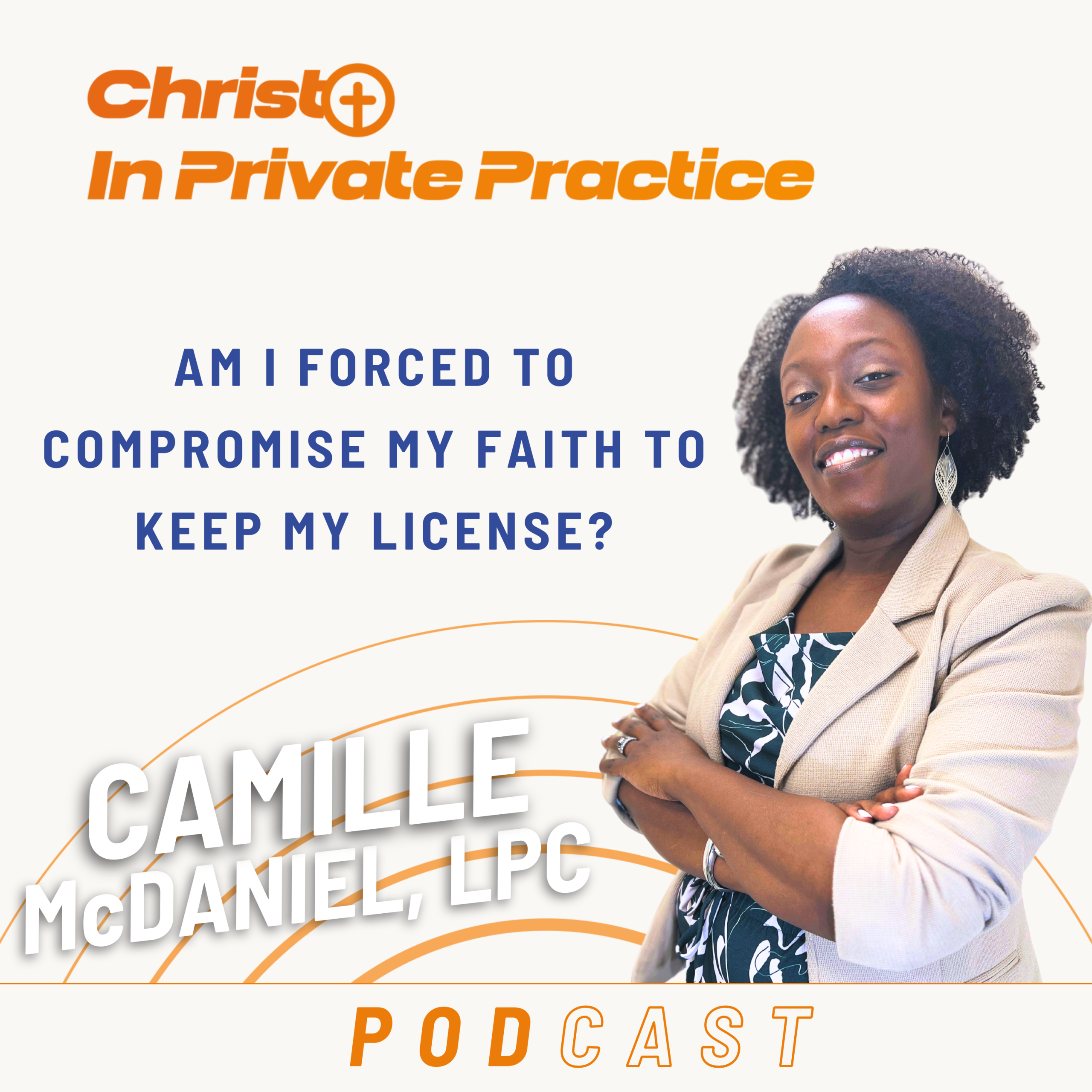
Am I Forced to Compromise My Faith to Keep My License?
This episode is eligible for 1 CE credit hour
Show Notes
Podcast Episode Transcript
Camille McDaniel (00:00)
This episode will qualify for one continuing education credit. You will be able to find this and many other trainings, both a live training taking place as well as on-demand trainings and a membership so that you pay just one flat rate every month and you will have access to a multitude of trainings that are going to continue to be uploaded to the library over at ChristinprivatePractice.com.
Welcome back to another episode. I’m so glad to have you here. And if you happen to be new, welcome. I’m glad that you stopped by to listen to this episode. And I hope that it really helps you as you are moving along your way in the field of mental health and faith integration. So, today’s episode, we are going to be talking about something that I’ve actually personally had ⁓ people talk to me about. I recently
Was actually asking some form of clarifying questions to someone online recently. And I thought, you know what? This is something that I think is coming up for quite a few clinicians who are Christians or Christian clinicians. And so let’s go ahead and put it out there and let’s just talk about it honestly, which is why the title of today’s podcast episode is Am I Forced to Compromise My Faith to Keep My License?
And that’s, I mean, that’s that’s a lot. there’s a lot that goes into that question. It’s a big one. And I think it’s it’s a big one because there are other questions underneath that question that come up for people that are really wondering, you know, what am I, what am I going to do? ⁓
There are thoughts about, like, you know, am I allowed to openly be a Christian counselor? And rightfully so, because even up until today, when you are listening to this podcast, whenever you’re listening to this podcast, there are colleagues that we have who may not be integrating their faith, and some
Some, I don’t want to make it seem like this is just everyone because it’s absolutely not, but there are some who are very vocal about believing that being a Christian counselor, integrating faith into your clinical practice is very unethical. And ⁓ and so when you come across these viewpoints and when you see them, you know, in conversation or when you see it in online, it can cause you to question what stance.
⁓ are you gonna have to take and can you keep your license? There’s some other questions that go behind the idea of will I have to you know compromise my faith in order to keep my license questions like you know can I speak about biblical principles ethically and do I affirm every worldview and am I allowed to specialize as a Christian counselor you know can I specialize in Christian counseling and
Am I slowly being pushed away from my own beliefs in order to keep my license or stay licensed?
And what happens when my convictions and a client’s worldview do not align. So these are just a few things that I know go underneath sometimes the question about keeping a license as well as keeping your faith. And I thought, you know what? Let’s let’s talk this out. And but before we actually jump into talking it out, let me say this: that before we get started, I know that this topic really and truly can cause a lot of people.
To feel sensitive. I know that this is going out to wherever it’s kind of you know published. So Apple and Spotify and YouTube and anywhere else that picks this up. So for anyone who’s listening who is not a regular listener of this podcast, this episode is not about being disrespectful to clients. It’s not about attacking anybody or attacking their worldview or their beliefs. ⁓ it’s not about withholding care and this is.
Is definitely not an us versus them type of mentality. This episode is about ethical practice, okay, and about people’s professional identity and their conscience and transparency.
And learning how to really, you know, walk forward as a Christian counselor with both compassion and integrity for the field of mental health. So, with that being said, let’s dive into ⁓ some of the emotional tension that Christian counselors are feeling. Because as I said, I have had conversations with people, whether I was in kind of like a group setting or whether I’m online and I’m
kind of hearing either exactly, you know, I’m I’m ready and prepared to give up my license if if need be, or ⁓ I am hearing that I don’t want to feel like I have to ⁓ compromise my beliefs and ⁓ and do things that don’t align with my values just so that I can keep my license. And you know, ⁓
This is something that there are people who are really wrestling with this because counselors are essentially saying I feel conflicted. I feel maybe a little cautious, some hesitancy. I feel like I have to hide my faith, or I’m afraid that ⁓ if I have my faith shown, whether it’s in my informed consent or it’s on my website or it’s in directories, that I’ll get complaints.
I’m afraid that it might cause harm to other people, or I don’t know if it’s even ethical anymore, you know, and people, Christian clinicians just don’t know if they’re allowed to fully ⁓ be a Christian clinician. I think that part of the problem is that many clinicians are carrying kind of a bit of fear mixed in together with misinformation.
And so some counselors genuinely do believe that if they openly hold biblical convictions, they could lose their license. And then others feel like emotionally exhausted because they are trying to move forward in their profession, separating themselves from their faith and their faith identity every time that they enter into a therapy room.
And then there are some clinicians who are realizing that maybe they’re being called specifically to practice from a faith-based perspective. Now, those are three different issues.
And we’re going to try to touch on ⁓ each one, okay? But people oftentimes just lump it together with this feeling that I’m not going to be able to hold true to my values and also be ethical. It kind of all gets lumped into the same bucket, but they are different. So let’s kind of let’s answer, let me answer first directly. Does licensure require you to abandon your faith? And the answer.
The
answer is no. Licensing bodies and ethical boards do not require a clinician to abandon their faith in order to keep their license. Okay. ⁓ licensure does not require that at all. Now, what does licensure require? Does licensure require ethical practice? Yes.
Yes, it does. Does licensure require respect for a client being able to make their own decisions or client autonomy? Yes, it does require that. And licensure also requires that we avoid coercing somebody to have thoughts and beliefs that align with what we feel is right.
We’re not going to coerce anybody. What we are going to do is ethically and professionally present information, allow our client to process it, allow our client to have, you know, whatever thoughts, whatever feelings they want to have. So we are to avoid coercion at all costs. Absolutely. But ethical counseling.
And biblical convictions, they are actually not enemies. They’re not. And this is really, I think, important to talk about because I think it is oftentimes presented as such that you cannot be an ethical clinician and also have a faith base and that go together, that you have to just choose one or the other.
Many licensing codes, like codes of ethics, licensing boards in different states, they absolutely allow counselors to openly practice from a faith-based perspective. Just as long as there is informed client consent, there has to be informed consent, that the consent is clear.
Again, we talked about, like I said just a minute ago, that there’s no coercion and that the counselor practices ethical boundaries. And that’s really important because sometimes Christian counselors begin operating, ⁓ you know, they’re providing their counseling services and they’re offering these counseling services from a place of fear, like just hoping they don’t get found out, hoping they don’t get a complaint, hoping no one snatches their license away from them, instead of operating from a place of just fact.
What is factual here? Because people can disagree with you, people will disagree with you integrating your faith, but is that what is fact or just their opinion? Because we want to move forward in what is fact. What do the licensing boards state? What are our ethical codes on this? And then we got we want to move forward from there. There is a difference.
⁓ and we’ll talk about this in a minute. There is a difference because I have seen online many a time where even the public is confused between Christian counseling and those who are licensed and provide Christian integration in their counseling. ⁓ there again, there’s there’s words that are used and they have many different meanings to different people. And I’ve seen where people are like, you know, Christian and counselor do not belong together.
And and that is because they are referring to some experiences from individuals who may not be held to any type of regulating board. And so therefore the individual is not, there’s nothing that you can really do per se if this person is being unethical, if this person is being unprofessional. There is no board that you can report them to.
there is no board that requires a standard be upheld by anybody who takes on this particular license or this particular ⁓ credential.
And so that’s where again the wording starts to get a little confused. And I think people then are overall just not sure about what it means if you happen to be a clinician who practices Christian faith integration or you know, calling yourself a Christian clinician. They just really don’t know what it means. And so it evokes a lot of strong feelings. ⁓
There’s a difference. There is a difference when you are a Christian counselor, when you are practicing faith integration. There’s a difference between respecting your clients and respecting their autonomy and respecting the fact that they will have whatever views they choose to have. And that respect does not mean that you affirm everything that they believe.
And everything that is a part of their history, their system, their beliefs, their culture, their everything, right? Those two actually, they’re not identical. Respecting a client and personally affirming all of that client’s beliefs and systems are that’s not the same thing. And we have to really be careful about that.
Because sometimes those get mixed together. And as counselors, we’re called to treat people with dignity and humanity, professionalism, and care.
But treating somebody respectfully and treating them with dignity and humanity and care and professionalism doesn’t require you to erase all of your worldview and your belief. And ⁓ my goodness, if I come across again where there’s some type of you know, projection or we’re insinuating that we should come without ⁓
Any worldview. We should just come neutral. We are a blank slate. Point out to me one person in this whole world who is nothing more than a blank slate and don’t include all the little babies who just got here. Okay? What adult professional is a blank slate and has no worldview? Who?
Every single clinician, every single human being has a world view, every single one. Now, some of the
Clinicians and some just some people in the world, no matter their profession, some of them will have a worldview that might be more secular, some might have a worldview that might be more nihilistic, some are going to be spiritually integrated, some are going to be Christian, some are going to be a multitude of other faith bases, but nobody enters the counseling room completely neutral.
That kind of like reminds me of when you hear people say, I I don’t see color. And it’s like, well, how why? Why do you take that position? You know, what does that mean to you? So that we are clear. And maybe I’m jumping to conclusions. Cause whenever I hear that, I’m like,
Well, then if you don’t see color, you’re just not seeing all the cultural richness and the history and the background and the beliefs that might go along with that individual. And some of it might be tied to their color. You know, so anyway, I will not get off on a tangent with that. But you understand what I’m saying when I say we do not enter the room neutral. Nobody does. So the key here is to ask ourselves are we practicing ethically? Are we being trained?
Transparent? Are we imposing our beliefs? And are we honoring our clients’ ability to have choice in the matter of their own mental health care? That’s really the important part of it. That’s what we really want to zone in on with this conversation. ⁓ because sometimes then the question is: well, how do I then counsel everyone?
This comes up a lot. This comes up a lot. Now we’re gonna get to because some people are like, well, I don’t know that I’m I’m called to counsel everyone. And we’ll get to that. Hang with me, all right? So
When we when we even ask that, sometimes what we’re really looking at behind that is, do I have to counsel everyone? Like, is that a requirement? In order for me to provide counseling care, in order for me to hold on to what I I feel are strong convictions and ⁓ the path that I’m supposed to be taking in this field, do I have to counsel everyone? Comes up.
Under sometimes people saying, like, well, how do I counsel everyone? Really, sometimes what they’re saying is, Do I have to counsel everyone? Like, is that a part of me holding on to my license? This is where I think things get a little interesting because look, some counselors are realizing that I don’t.
Actually, want to build a general practice. I don’t want to have just, you know, a practice where I can just I can meet the needs of anyone who walks through. And I don’t think that that is unusual at all. Look at our field, the whole field of mental health. I don’t think that’s unusual to say, I don’t really want a general practice. Some of us do. Some of us are called to have a more general practice, right? But think about it. We already are very
Accepting, it is very standard in our profession that people are going to specialize in certain aspects of mental health care. Some counselors only work with trauma, some only work with couples, some only work with children, some only work in addictions or eating disorders, or only work with athletes or executives, or a specialization in ADHD, or for
You know, there’s a just so many different specializations. I’d be here for a while if I broke them all down. But no one really panics when someone says, ⁓ I specialize in working with children and adolescents.
Okay, but no one says, well, what about if someone’s coming for couples counseling? What what if what if that but what do you do then? What if that person wants to be seen? People are like, well, I just let them know what my specializations are. And if I have a referral, I will give them a referral. If I don’t have a referral, I will help them to know where they can actually go as far as directories or as far as other resources that are freely available for individuals who are looking for couples counseling, right?
But it is, there’s there’s a lot. ⁓ it’s very loaded when ⁓ when someone says, I want to specialize in Christian counseling. And then that’s where people are like, ⁓ well, be careful. Well, okay, well, how are you gonna do that exactly? Well, what does that mean exactly? Right. And I think this is the reason why that comes up, and I think you know this as well.
There’s a difference between an ethical specialization and discriminatory behavior, but those are not the same thing.
So, people who are working with children and adolescents are not discriminating against individuals who are wanting to come for marriage counseling. They’re not discriminating against people with eating disorders or anybody else who’s not involved or under the umbrella of child and adolescence mental health care, right? They are just saying this is where I feel called to do my work. This is where I do my best work. This is where I feel led to contribute to the feed.
Field
of mental health. It is not being discriminatory to have a specialization, but we do need to be careful about how we are specializing so that it doesn’t become discriminatory. Because a counselor can ethically say, my practice specializes in Christian counseling and faith integration. ⁓
Especially when it’s clearly communicated, clients understand the framework, informed consent is provided, and then there are referrals handled, you know, when ethically needed. Okay. And that is how we want to think about this. Instead, sometimes we might find that people will say, ⁓ I want to only work with people who are Christians.
Not necessarily that I want to offer Christian counseling. I only want to work with people. I only want to accept people into my practice who are Christians. And
If that comes up, that’s generally because the person is thinking back to ⁓ the title of the episode, they’re thinking, because if I don’t have people come in who are Christians, then I won’t be able to stay within my value system. I won’t be able to actually work from the framework that I work from. I’ll probably get complaints or I might lose my license or
I think it’s still fear-based that leads them down that path. And they think, like, if I if I’m working with people who are Christians, then there is some safety in that. And that is not true. What you do have to do though is be very clear, upfront, transparent about the framework you use, how it’s going to be used, and you put that out there, and then
Those who still desire to come will come, whether they have your belief system or not. I have a lot of clients who do not share my belief system and they still come. They see that my website advertises it as such. They see, even when they meet with me in my office, they see that there’s a cross on my wall.
They see these things, they know ahead of time, they know what they’re going to get from me as a clinician before they come and they still come. Clients choose specializations all the time. So I have clients who are coming who specifically are wanting ⁓ faith integration. And there are
Clients who are choosing specialists because they specifically want biblical integration. They specifically want scripture involved. They want prayer. They want discussion about spiritual struggles. They want someone who understands discernment and faith. And a counselor who understands their worldview without them having to explain everything is something that people are also looking for.
So there is a legitimate clinical niche by being a Christian integrated therapist.
We can also, and we need to talk about this too, because this is also important and comes up. We can have compassion for our clients without compromise. And we can still be ethical and still be professional. I want to be very careful here because this matters, and I want to be clear.
Sometimes Christian counselors will fear that kindness means compromise. And other times people might assume that like disagreeing with something automatically equals hatred. And neither of those are true at all because you can care for people deeply. You can treat them with dignity, compassionately, ethically, professionally, and still maintain your biblical framework.
Compassion
and conviction are not at odds with each other. And I think that some counselors kind of are exhausted because they’ve been trying to function as though compassion and conviction cannot align and they just feel torn internally because they’re trying to function ⁓ with an idea that compassion and conviction are.
are at odds with each other. Now, there is a way to practice it with integrity and compassion, you know, and humility and clarity, but I do think that Christian counselors are going to need to walk in wisdom. ⁓
Because and this goes back to when I was just talking about how some people are confusing the word Christian, the words Christian counselor, whether the person is licensed, they’re they’re kind of getting everything jumbled up because in society the word Christian counselor doesn’t mean just one thing to one person. So it does actually in different spaces look like something different, mean something different. People have had different experiences with regards to Christianity.
Christian counseling or Christian counselors. And so
Some unfortunately have had experiences with Christian counseling. And for them, when they say it, they’re meaning someone with poor boundaries and someone who’s going to be preaching sermons to them in their counseling sessions, and someone who’s going to try to coerce them to believe the way they believe and think the way that they think. And they’re they’re going to shame them if they don’t, and they’re going to, you know, make them feel condemnation and
They’re going to try to spiritually override all of their clinical issues. And you know, and that’s not ethical, but unfortunately, that is sometimes what people have experienced, and it is causing confusion when they think about offering Christian counseling or you know, what it means to be a Christian integrated therapist.
Christian counseling should not be about forcing scripture. It’s not about spiritually bypassing, excuse me, spiritually bypassing like trauma. It’s not about ignoring research. And it’s not about dismissing mental illness.
Can I just say I think that part is very confusing? I don’t think we have enough time on this one podcast episode to dive into it exactly. But I’ve seen where where preachers and ⁓ and those in the Christian spaces who have a platform to speak to a lot of people in like church settings and conferences where they have said, you know, you don’t need a counselor. ⁓ you need to pray, you need to go to God as if the Lord.
Has not placed his children in the field of mental health as well. And as if we are not in a fallen world. So again, like I said, I won’t go do too deep because I can go down a rabbit hole. I won’t, but I will say that it is important for us to recognize that if someone struggles with mental illness, that is not an absence of God. That is not an absence of faith. That is not an absence of prayer life.
Because we are in a fallen world. And in this fallen world, sickness and illness and disease and many other things are rampant, right? And the same way that we we don’t say to people, you don’t need a doctor for that high blood pressure, you just need to pray. You don’t need glasses because you have an astigmatism, you just need to pray. You don’t need, you know, a counselor.
When you’re struggling with your emotions, you just need to pray. That would also suggest that
You know, all counseling is about anxiety and depression. And it’s not. There is a multitude, there are a multitude of reasons why people come to counsel to get counsel, to get wise counsel on different things that are going on in their life. All right, I’m gonna step off the soapbox, but you hear me, right? I that just bothers me when I hear that. It’s like a lack of understanding that then has people.
Sometimes isolated and feeling like they’re not praying enough. As if the Bible doesn’t show examples where people struggled and the Lord did not deliver them from that struggle. I mean, the Apostle Paul, I mean, he has left us with so many of God’s, you know, an understanding of God’s character.
The apostle Paul talks about the thorn in his side that wasn’t removed in he asked multiple times. And that thorn was used for his glory, for God’s glory. But
There was even our Lord and Savior who was in the Garden of Gethsemane. And what did he say to his father when he was praying before he was crucified, the night before he was crucified? If it if it be so for you to take this cup from me, like this whole heaviness from me, then please do, right? But not my will, but yours be done. There are times where the Lord will deliver people from things, and I’m sure many of you all have examples of that. There are times where the Lord will not deliver.
From a thing, there are times where the Lord will say, Hold on just a little while longer, just wait. But in all the things that He says, He is still righteous, He is still wise, He is still sovereign, He’s God. So when people say that, that just ⁓ as you can see, that just gets me talking a little bit more. Let me jump back on into what we were talking about for today with our license and our convictions, right? So
Ethical Christian counseling, it requires that we have both clinical competence.
And spiritual maturity. You know, it’s this is it’s not gonna be about what some unfortunately some people have experienced with, you know, some poor boundaries or maybe some preaching or some coercion and we’re not proselytizing and all of that. No, we’re not that’s that’s not what we are doing. Now, again, I always remember that there are some who may listen to me and they are pastors and they are, you know, they have their license, they are ordained, they have gone through their training, and they also then went and ⁓ got their training as.
Licensed clinicians in the field of mental health, and that is a that’s a different dynamic, and they still are held to making sure that they are very clear, they are open, they are honest about what the person will receive when they come to them. All right? Now
Let me, I said I was going to also get to this category of people and I do not want to ⁓ skip over it, but let’s also jump into what if you feel spiritually torn in your work. ⁓ you know, for the counselors who are listening and they are just they’re tired, they’re they’re not.
upset about you know the fact that they are not sure you know if they can hold on to their convictions and biblical framework as well as their license. They’re not angry about it. They’re just tired. They’re exhausted.
And they’re conflicted. They’re just not sure. It’s like I just don’t know where I fit anymore. Or I feel spiritually divided here and it’s not comfortable. Or maybe they’re saying, you know, you might be thinking that you feel constantly like you’re having to filter yourself. You just can’t be yourself. And then if that happens to be you, if you happen to be in that bucket, then I encourage you to prayerfully ⁓
Yeah.
The Lord and ask yourself something. What kind of practice have you been called to build? Because sometimes the issue is actually not Christianity versus ethics and you know, biblical framework and your license. Sometimes the issue really is that you’re trying to build a practice that no longer aligns with your actual calling. Some clinicians are called to a more general mental.
Health setting, a broader community mental health setting, but others are called specifically toward faith-based work across the board. And others might be called to blend, you know, to be able to do both, be able to offer.
A biblical framework and know how to do that ethically, no matter who walks in their doors. Like they are going to receive people who are coming who may want faith and may not want faith integrated. And they’re not just saying, no, I only am going to offer Christian counseling. We’re going to explicitly be talking about the Bible. We’re going to explicitly be talking about the Lord.
That may not be what they’re called to. So some are called to explicitly incorporate in all that they do the explicitly, right? And I want to be very mindful that I’m using that term person purposely ⁓ because you are still able to use a biblical framework.
And principles, even when the person coming does not want Christian integration. And it is not unethical because, again, it’s not coercion of any type. And this will be, I think, a training I was kind of toying with putting this training together because you can have a biblical framework, a biblical anthropology for how we address human nature. And some of that is already being presented in some of these evidence-based treatment modalities that.
The Bible already talked about a long time ago. Anyway, as I move forward, like I said, the Lord might be calling some people to a large, broad setting, ⁓ community mental health, a more general setting. The Lord might be calling some of you to just specifically operate based on faith based only work. And some of you are going to be meeting, you know, both people as you as you advertise what you’re doing. But it is really important to be clear.
And there shouldn’t be any fear. Fear cannot be the primary architect of your practice. Not fear of man, not fear that you might get complaints, not fear of licensing boards or the culture at large, not fear that you might lose some clients. We cannot build a practice on fear. Absolutely not. ⁓
that reminded me of a little song. ⁓ who knows the song On Christ the Solid Rock I Stand? All other ground is sinking sand. All other ground is sinking sand. I don’t love that song. ⁓ but that’s what came to me as I was explaining this. You know, it can’t be based on fear. Absolutely not. We have to build our practices on fact, on truth, in wisdom, with ethics and competence. ⁓
But definitely not fear. So are Christian counselors forced to compromise their faith to keep their license? No.
But we are called to practice ethically and with an understanding and acceptance that our clients have the right to choose to do things according to their own desire. ⁓ we are going to accept the fact that clients have that autonomy. We’re not going to use any coercion and you know, we are going to maintain our
Our competence through our trainings and our readings and our clinical supervision and our consultations and all of that. And so, and we’re going to communicate honestly about the services that we provide. And I believe that Christian counselors can do that while still remaining grounded in a biblical framework. Okay. So
I hope that this has provided some answers. I hope that this is giving you a lot to think about. Thank you so much for joining me in today’s episode. And I hope that you join me next week for another brand new episode. This episode, again, and many more, can be found on the Christ in Private Practice website. And many of them are offering one CE ⁓ for your continuing education hours.
So until next time, until we meet again, God bless.
